Recruiting wasn't the hard part
Recruiting wasn't the hard part
When I first spoke with recruiters, I assumed they needed another place to find jobs.
When I first spoke with recruiters, I assumed they needed another place to find jobs.
I was wrong.
I was wrong.
Finding jobs wasn’t the hard part.
Finding jobs wasn’t the hard part.
Managing everything around them was.
Managing everything around them was.
Every hiring workflow meant jumping between multiple tools just to stay organized.
Every hiring workflow meant jumping between multiple tools just to stay organized.
SuperHire wasn’t built to replace job boards.
SuperHire wasn’t built to replace job boards.
It was built to bring jobs, candidates and communication into one place.
It was built to bring jobs, candidates and communication into one place.
What recruiters taught me
What recruiters taught me
The more recruiters I spoke with, the more I realized they needed a better way to manage everything around hiring.
The more recruiters I spoke with, the more I realized they needed a better way to manage everything around hiring.
Recruiters decided in seconds
Recruiters decided in seconds
They scanned only a few details before deciding whether a role was worth pursuing.
They scanned only a few details before deciding whether a role was worth pursuing.
WHAT I CHANGED
I kept only the information recruiters needed to make a quick decision.
I kept only the information recruiters needed to make a quick decision.
Context switching slowed everything
Recruiters constantly jumped between spreadsheets, SMS, emails and job boards.
WHAT I CHANGED
I brought jobs, candidates, and communication into a single workflow.
Context switching slowed everything
Recruiters constantly jumped between spreadsheets, SMS, emails and job boards.
WHAT I CHANGED
I brought jobs, candidates, and communication into a single workflow.
Waiting created uncertainty
After submitting candidates, recruiters had no clear visibility into what happened next.
WHAT I CHANGED
I designed a timeline that gave recruiters a place to track each candidate.
Waiting created uncertainty
After submitting candidates, recruiters had no clear visibility into what happened next.
WHAT I CHANGED
I designed a timeline that gave recruiters a place to track each candidate.
Repetitive work broke momentum
Recruiters repeatedly entered the same candidate information across different roles.
WHAT I CHANGED
I reused candidate information while keeping role specific validation manual.
Repetitive work broke momentum
Recruiters repeatedly entered the same candidate information across different roles.
WHAT I CHANGED
I reused candidate information while keeping role specific validation manual.
Helping recruiters decide faster
Helping recruiters decide faster
Most recruiters decided within seconds whether a role was worth their time.
Most recruiters decided within seconds whether a role was worth their time.
Everything revolved around one question.
Everything revolved around one question.
“Is this a role I’m confident sourcing for?”
“Is this a role I’m confident sourcing for?”
The choice between grid and table
The choice between grid and table
I originally designed a table view as the layout will allow more jobs to be displayed.
I originally designed a table view as the layout will allow more jobs to be displayed.
Recruiters didn’t like it.
Recruiters didn’t like it.
"It feels like another Excel sheet."
"It feels like another Excel sheet."

BEFORE - TABLE VIEW
Recruiters already spent most of their day working in spreadsheets.
Recruiters already spent most of their day working in spreadsheets.
They wanted something easier to scan.
They wanted something easier to scan.
I removed the table and committed to a grid view.
I removed the table and committed to a grid view.

AFTER - GRID VIEW
WHAT I LEARNED
Great interfaces don’t show more information. They help people make decisions faster.
Great interfaces don’t show more information. They help people make decisions faster.
I removed information instead of adding it.
I removed information instead of adding it.
My first version of the job card showed more information because I thought it would help recruiters make better decisions.
My first version of the job card showed more information because I thought it would help recruiters make better decisions.
Recruiters consistently focused on just four things: role, experience, compensation and recruiter earnings.
Recruiters consistently focused on just four things: role, experience, compensation and recruiter earnings.

JOB CARD
Everything else like the job and company details was pushed to "View Details" section.
Everything else like the job and company details was pushed to "View Details" section.

JOB DETAILS

COMPANY DETAILS
WHAT CHANGED
Recruiters could scan more jobs without less important information getting in the way.
Recruiters could scan more jobs without less important information getting in the way.
Finding the right job was only the beginning. The next challenge was helping recruiters submit candidates without breaking their flow.
Finding the right job was only the beginning. The next challenge was helping recruiters submit candidates without breaking their flow.
Helping recruiters stay in flow
Helping recruiters stay in flow
Once recruiters claimed a job, the challenge changed.
Once recruiters claimed a job, the challenge changed.
Finding opportunities was no longer the hard part.
Finding opportunities was no longer the hard part.
Submitting candidates without losing context was.
Submitting candidates without losing context was.
Recruiters constantly referred back to the job while filling candidate details.
Recruiters constantly referred back to the job while filling candidate details.
I kept recruiters in context.
I kept recruiters in context.
A modal would have forced them to keep switching between the form and the job details.

SUBMIT CANDIDATE - BEFORE
I kept the submission flow beside the job so they never lost context.
I kept the submission flow beside the job so they never lost context.

SUBMIT CANDIDATE - AFTER
WHY IT WORKED
Recruiters could review job details and submit candidates without leaving the page.
Recruiters could review job details and submit candidates without leaving the page.
I added friction on purpose.
I added friction on purpose.
Most products try to remove every extra step.
Most products try to remove every extra step.
I did the opposite.
I did the opposite.
Recruiters manually verified the employer’s must have skills and qualifying criteria before submitting a candidate.
Recruiters manually verified the employer’s must have skills and qualifying criteria before submitting a candidate.

MANUAL CHECK
It added a small pause before submission, giving recruiters one last chance to verify the candidate.
It added a small pause before submission, giving recruiters one last chance to verify the candidate.
WHAT I LEARNED
The fastest workflow isn’t always the best one. Sometimes a small pause builds trust.
The fastest workflow isn’t always the best one. Sometimes a small pause builds trust.
Submitting a candidate wasn’t the end of the workflow. It was the beginning of a journey recruiters needed visibility into.
Submitting a candidate wasn’t the end of the workflow. It was the beginning of a journey recruiters needed visibility into.
Reducing uncertainty after submission
Reducing uncertainty after submission
Once recruiters submitted a candidate, their work changed.
Once recruiters submitted a candidate, their work changed.
They stopped asking,
They stopped asking,
“What should I do next?”
“What should I do next?”
Instead they started asking,
Instead they started asking,
“What’s happening now?”
“What’s happening now?”
I made progress visible.
I made progress visible.
Recruiters didn’t want to keep asking for updates.
Recruiters didn’t want to keep asking for updates.
They wanted confidence that nothing had been missed.
They wanted confidence that nothing had been missed.
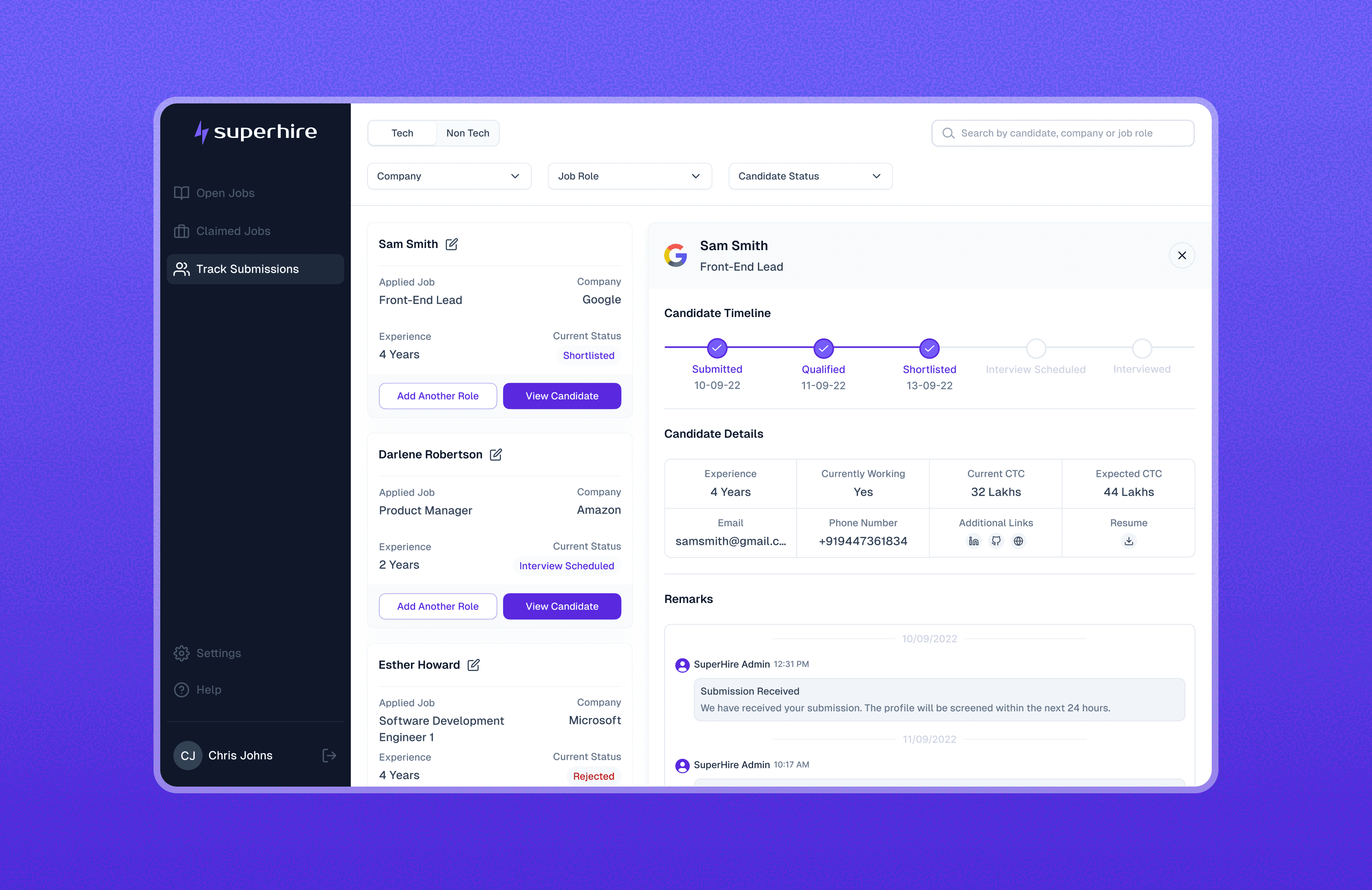
I designed a shared timeline that showed every stage from submission to interview.
I designed a shared timeline that showed every stage from submission to interview.

CANDIDATE TIMELINE
WHY IT WORKED
Recruiters could check progress themselves instead of relying on emails or follow-up calls.
Recruiters could check progress themselves instead of relying on emails or follow-up calls.
I kept every conversation attached to the candidate.
I kept every conversation attached to the candidate.
Recruiters, employers and the SuperHire team were already communicating.
Recruiters, employers and the SuperHire team were already communicating.
The problem was losing context.
The problem was losing context.
Instead of sending people back to email or WhatsApp, every discussion stayed attached to the candidate.
Instead of sending people back to email or WhatsApp, every discussion stayed attached to the candidate.

CONVERSATION WINDOW
WHAT I REALIZED
People don’t just need updates. They need context.
People don’t just need updates. They need context.
I stopped tracking where our responsibility ended.
I stopped tracking where our responsibility ended.
At first, I wanted the timeline to continue until the candidate joined the company.
At first, I wanted the timeline to continue until the candidate joined the company.
The more I understood the business, the more I realized our responsibility ended much earlier.
The more I understood the business, the more I realized our responsibility ended much earlier.
SuperHire wasn’t trying to manage the entire hiring process.
SuperHire wasn’t trying to manage the entire hiring process.
Our promise was simple: deliver interview ready candidates.
Our promise was simple: deliver interview ready candidates.
Everything after that belonged to the employer.
Everything after that belonged to the employer.
So I intentionally ended the recruiter journey where our responsibility ended.
So I intentionally ended the recruiter journey where our responsibility ended.
WHAT I LEARNED
Great products don’t solve every problem. They solve the right problem.
Great products don’t solve every problem. They solve the right problem.
Recruiters now had everything they needed to source, submit and track candidates.
Recruiters now had everything they needed to source, submit and track candidates.
The next challenge wasn’t another design problem.
The next challenge wasn’t another design problem.
It was a product decision that changed how we thought about the marketplace.
It was a product decision that changed how we thought about the marketplace.
When our assumptions were wrong
When our assumptions were wrong
Building an MVP meant making a lot of assumptions.
Building an MVP meant making a lot of assumptions.
Some were right.
Some were right.
Some weren’t.
Some weren’t.
The ones that were wrong taught me the most.
The ones that were wrong taught me the most.
Scarcity didn’t create quality.
Scarcity didn’t create quality.
We believed that limiting the number of claims per job would improve candidate quality because recruiters would spend more time on each role.
We believed that limiting the number of claims per job would improve candidate quality because recruiters would spend more time on each role.
The opposite happened.
The opposite happened.
Recruiters rushed to claim jobs before anyone else did.
Recruiters rushed to claim jobs before anyone else did.
Many claimed roles without fully understanding the requirements.
Many claimed roles without fully understanding the requirements.
Others stopped returning because all the jobs they wanted had already been claimed.
Others stopped returning because all the jobs they wanted had already been claimed.
We removed claim limits and instead paused jobs only after enough candidates had been submitted.
We removed claim limits and instead paused jobs only after enough candidates had been submitted.
WHAT I LEARNED
People don’t always behave the way we expect. Good incentives matter just as much as good interfaces.
People don’t always behave the way we expect. Good incentives matter just as much as good interfaces.
We rewarded the wrong outcome.
We rewarded the wrong outcome.
Our first incentive model rewarded recruiters only when a candidate completed one month at the company.
Our first incentive model rewarded recruiters only when a candidate completed one month at the company.
In practice, recruiters had no control over many parts of that journey.
In practice, recruiters had no control over many parts of that journey.
Candidates declined offers.
Candidates declined offers.
Some never joined.
Some never joined.
Others left before completing the first month.
Others left before completing the first month.
Recruiters had already invested hours sourcing, screening and coordinating interviews.
Recruiters had already invested hours sourcing, screening and coordinating interviews.
Yet they earned nothing.
Yet they earned nothing.
We changed the model to reward every shortlisted candidate instead.
We changed the model to reward every shortlisted candidate instead.
WHAT I LEARNED
People should be rewarded for the value they control, not the outcome they can’t.
People should be rewarded for the value they control, not the outcome they can’t.
Some ideas needed to wait.
Some ideas needed to wait.
We also explored a tier system that rewarded experienced recruiters with more job opportunities and higher commissions.
We also explored a tier system that rewarded experienced recruiters with more job opportunities and higher commissions.
The idea made sense.
The idea made sense.
The timing didn’t.
The timing didn’t.
As a new marketplace, our priority was attracting recruiters, not creating hierarchy between them.
As a new marketplace, our priority was attracting recruiters, not creating hierarchy between them.
We moved it into the roadmap instead.
We moved it into the roadmap instead.
Not every good idea belongs in an MVP.
Not every good idea belongs in an MVP.
WHAT I LEARNED
Building the right product often means saying “not yet” instead of “yes.”
Building the right product often means saying “not yet” instead of “yes.”
These decisions reminded me that building products isn’t about getting everything right the first time.
These decisions reminded me that building products isn’t about getting everything right the first time.
It’s about staying close to your users and being willing to change course when you’re wrong.
It’s about staying close to your users and being willing to change course when you’re wrong.
The ecosystem behind the experience
The ecosystem behind the experience
The recruiter experience was only one part of SuperHire.
The recruiter experience was only one part of SuperHire.
I also designed the employer portal and the internal operations platform that powered the marketplace behind the scenes.
I also designed the employer portal and the internal operations platform that powered the marketplace behind the scenes.
I chose to focus this case study on the recruiter experience because it was where the most important product decisions happened.
I chose to focus this case study on the recruiter experience because it was where the most important product decisions happened.
What happened after launch.
What happened after launch.
SuperHire launched publicly, and we raised seed funding.
SuperHire launched publicly, and we raised seed funding.
The most meaningful feedback came from the recruiters using it every day.
The most meaningful feedback came from the recruiters using it every day.
Those conversations mattered just as much as the growth metrics.
Those conversations mattered just as much as the growth metrics.
They told me we weren’t just building another hiring platform.
They told me we weren’t just building another hiring platform.
We were changing the way recruiters worked.
We were changing the way recruiters worked.
500+
500+
Monthly active recruiters
Monthly active recruiters
100+
100+
Active employers
Active employers
< 48 hrs
< 48 hrs
Most roles received submissions
Most roles received submissions
30%
30%
Increase in employer shortlisting
Increase in employer shortlisting
Looking back
Looking back
When I joined, I thought good design meant making every interaction as fast and frictionless as possible.
When I joined, I thought good design meant making every interaction as fast and frictionless as possible.
This project challenged that belief.
This project challenged that belief.
Some moments need less friction.
Some moments need less friction.
Others need more.
Others need more.
The challenge isn’t removing friction everywhere.
The challenge isn’t removing friction everywhere.
It’s knowing where it belongs.
It’s knowing where it belongs.
It’s a lesson I still carry into every product I design today.
It’s a lesson I still carry into every product I design today.

SuperHire
Recruitment Marketplace
Helping recruiters focus on hiring again
Helping recruiters focus on hiring again
Designed the core recruiter experience for a recruitment marketplace that brought jobs, candidates, and communication into one place, supporting 500+ recruiters and 100+ employers.
Designed the core recruiter experience for a recruitment marketplace that brought jobs, candidates, and communication into one place, supporting 500+ recruiters and 100+ employers.
Role
Role
Founding Product Designer
Founding Product Designer
Ownership
Ownership
Designed the recruiter experience, from research and product strategy to developer handoff.
Designed the recruiter experience, from research and product strategy to developer handoff.
Team
Team
Leadership • PM • 4 Engineers • QA • Me
Leadership • PM • 4 Engineers • QA • Me
Leadership • PM • 4 Engineers • QA • Me
Timeline
Timeline
2022 - 2024 (Multiple releases)
2022 - 2024 (Multiple releases)