SUPERHIRE • SHIPPED
ROLE
Founding Product Designer
TIMELINE
Jan 2022 - Jan 2024
(Multiple releases)
TEAM
1 PM
4 Engineers
1 Designer (Me)
SKILLS
Product Design
User Research
Prototyping
TL;DR
Recruiters struggled to manage jobs, candidate submissions, and communication across disconnected tools, with little visibility into candidate progress. I designed a recruiter portal that brought these workflows together, simplifying job discovery, submissions, and follow-ups. SuperHire grew to 500+ monthly active recruiters and 100+ active employers, with most roles receiving submissions within 48 hours and employer shortlisting increasing by 65%.
Context
SuperHire is an HR-tech platform that helps companies hire pre-vetted, interview-ready candidates through a network of freelance recruiters.
This case study focuses on the recruiter experience. The recruiter portal is one part of the SuperHire ecosystem, alongside the employer and admin portals.
Overview
When I first spoke with recruiters, I assumed they needed another place to find jobs. I was wrong.
Recruiters were already finding opportunities. The bigger problem was managing jobs, candidates, and communication across spreadsheets, emails, messages, and job boards.
SuperHire was built to bring that workflow into one place.
Problem
Recruiters often decided within seconds whether a job was worth pursuing. Once they found one, they had to keep referring back to the job description while submitting candidates. After submission, they had little visibility into what happened next.
I wanted to make the entire workflow simpler without removing the information recruiters actually needed.
Research
The more recruiters I spoke with, the more I realized they needed a better way to manage everything around hiring. The conversations showed four recurring problems:
They scanned only a few details before deciding whether a role was worth pursuing.
Recruiters constantly jumped between spreadsheets, SMS, emails and job boards.
After submitting candidates, recruiters had no clear visibility into what happened next.
Recruiters repeatedly entered the same candidate information across different roles.
One of the biggest insights was simple:
Opportunity
Instead of trying to build another job board, I focused on the workflow around each job and candidate.
That meant simplifying job discovery, keeping recruiters in context while submitting candidates, and making progress visible after submission.
Solution
My first version used a table because it could show more jobs at once.
Recruiters pushed back.
"It feels like another Excel sheet."
Since recruiters already spent much of their day in spreadsheets, I moved to a grid layout.

BEFORE

AFTER
I also simplified the job card around the four things recruiters cared about most: role, experience, compensation, and recruiter earnings.

Everything else like the job and company details was pushed to "View Details" section.

JOB DETAILS

COMPANY DETAILS
Submitting a candidate required recruiters to refer back to the job requirements.
Instead of putting the form in a separate modal, I kept the submission flow beside the job so recruiters could review the requirements while entering candidate information.

BEFORE
Instead of putting the form in a separate modal, I kept the submission flow beside the job so recruiters could review the requirements while entering candidate information.

AFTER
I also added a manual verification step before submission. Recruiters confirmed the employer's must-have requirements before sending a candidate.

MANUAL CHECK
It added a small amount of friction, but gave them one final opportunity to catch a mistake.
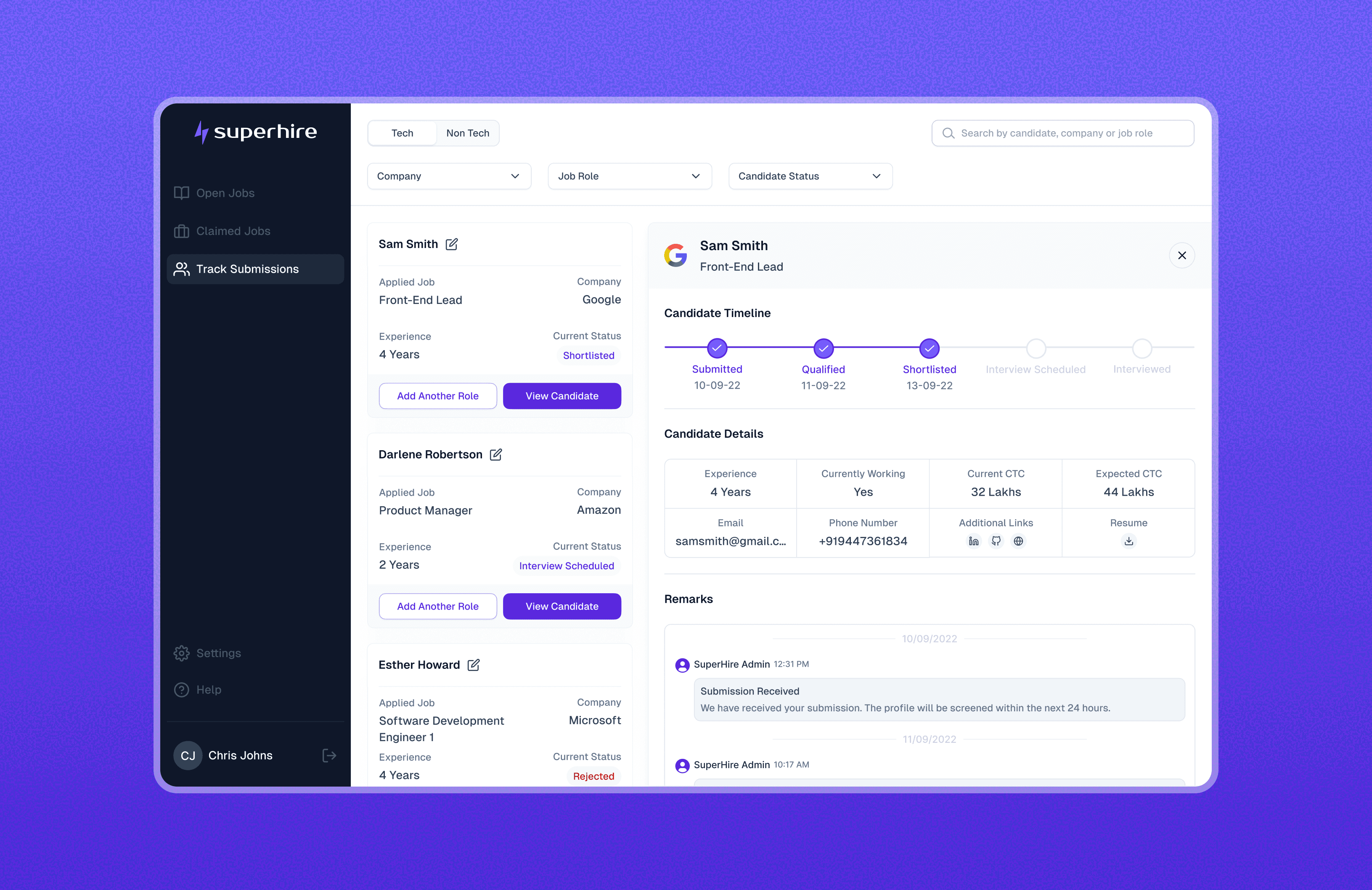
Submitting a candidate wasn't the end of the workflow. Recruiters wanted to know what was happening next.

CANDIDATE TIMELINE
I designed a candidate timeline showing progress from submission through interview, so recruiters could check updates without relying on emails or follow-up calls.

CONVERSATION WINDOW
I also kept conversations attached to the candidate, giving recruiters, employers, and the SuperHire team one place to communicate.
We initially limited the number of recruiters who could claim a job because we thought scarcity would encourage better sourcing. Instead, recruiters rushed to claim jobs before someone else did.
We removed claim limits and instead paused jobs after enough candidates had been submitted.
Our first incentive model also rewarded recruiters only when a candidate stayed at a company for a month. Since recruiters couldn't control that outcome, we changed the model to reward shortlisted candidates instead.
These decisions showed me that product design isn't only about interfaces. Product rules can change how people behave.
Results
Learnings
SuperHire changed how I think about friction. Some parts of the experience needed to be faster. Others needed a small amount of friction to build trust.
The biggest lesson was knowing where to simplify, where to slow things down, and when not to build something at all.